

Manual vs. Automated Weighbridge: Which One Is Better for Your Business?
In industries such as manufacturing, steel, cement, mining, logistics, construction, agriculture, and power generation, accurate vehicle weighing is an important part of daily operations. Every truck entering or leaving a facility may need to be weighed, recorded, verified, and connected with dispatch or receiving information.
Traditionally, businesses have depended on operators to manage this process manually. However, as vehicle traffic increases and businesses become more focused on operational efficiency, security, and digital records, many companies are moving toward an Automated Weighbridge solution. Modern automation can connect weighing equipment with RFID, ANPR cameras, sensors, barriers, software, and ERP systems.
So, in the Manual vs Automated Weighbridge comparison, which option is better for your business? The answer depends on your vehicle volume, operational requirements, security concerns, workforce, and future growth plans. In this article, we will compare manual and automated weighbridge systems, explain their advantages and limitations, and help you understand why weighbridge automation is becoming an important investment for modern industrial businesses.
What Is a Manual Weighbridge?
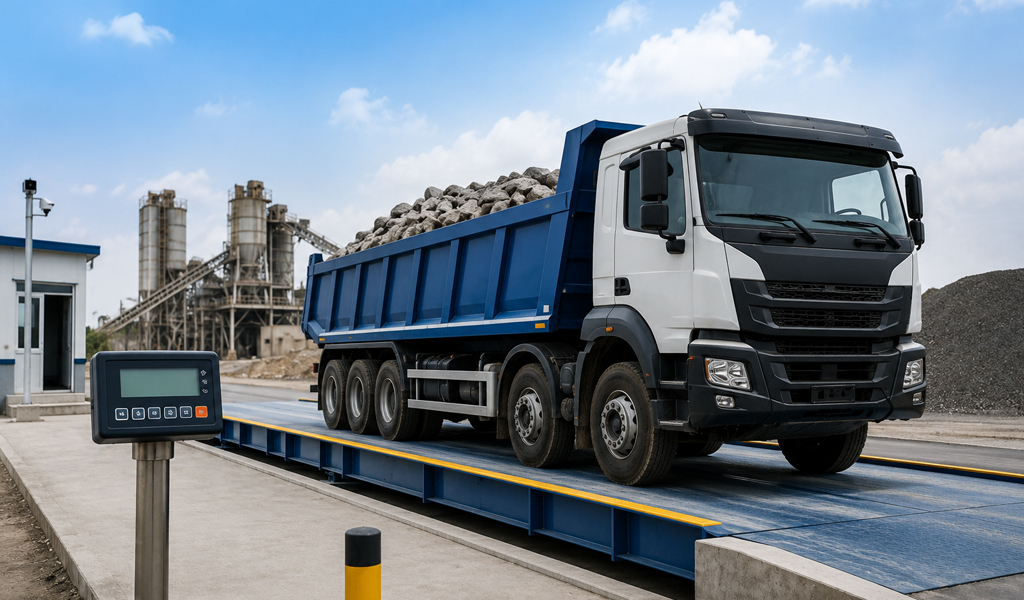
A manual weighbridge is a traditional vehicle weighing system where an operator manages most of the weighing process. When a truck arrives, the operator checks the vehicle details, enters or writes the required information, records the weight, and generates a weighment slip.
Depending on the business process, the operator may also verify the purchase order, delivery challan, material type, vehicle number, customer information, gross weight, tare weight, and net weight. These activities require continuous human involvement and proper coordination between the weighbridge operator and other departments.
Common activities in a manual weighbridge include:
- Vehicle identification by an operator
- Manual entry of vehicle information
- Manual weight recording or verification
- Printing or writing weightment slips
- Checking documents
- Maintaining registers or computer records
- Manual entry of material information
- Manual calculation or verification of net weight
- Coordinating vehicle entry and exit
- Preparing reports manually
A manual system can work well for businesses with a small number of vehicles and relatively simple operations. However, when hundreds of trucks need to be processed every day, manual dependency can create delays, errors, paperwork, and security challenges.
What Is an Automated Weighbridge?
An Automated Weighbridge is a technology-driven weighing solution that reduces or eliminates manual intervention during vehicle weighing. It combines weighing hardware with software and automation devices to identify vehicles, capture weight information, control vehicle movement, and store transaction data digitally.
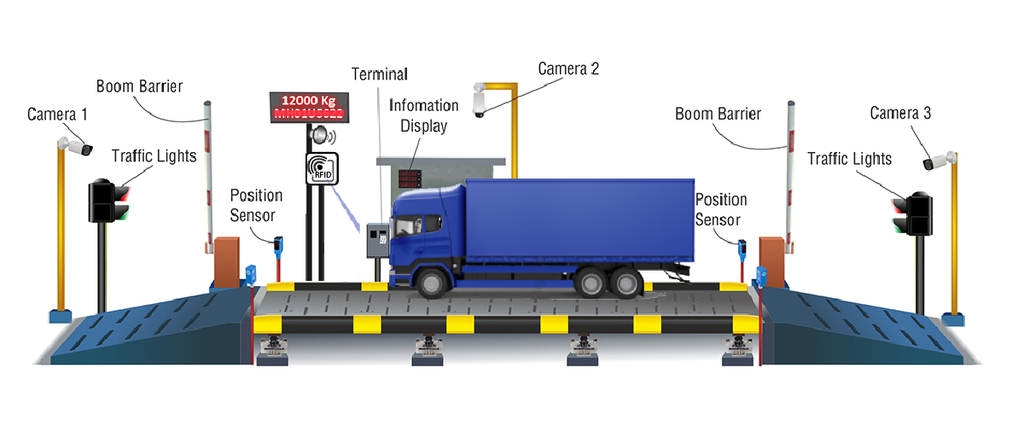
A modern automated weighbridge system can include RFID readers, ANPR cameras, boom barriers, traffic signals, sensors, LED displays, voice guidance, weighbridge software, CCTV cameras, and ERP integration. These components work together to create a controlled and traceable weighing process. Instead of depending entirely on an operator, the system can automatically identify an authorized vehicle, guide it onto the weighbridge, verify positioning, capture weight, record transaction information, and control entry or exit.
A typical automated weighbridge system may include:
- Digital weighbridge and weight indicator
- RFID vehicle identification
- ANPR number plate recognition
- Vehicle positioning sensors
- Automatic boom barriers
- Traffic lights or signals
- CCTV cameras
- LED display boards
- Voice announcement system
- Weighbridge automation software
- Digital weight measurement records
- ERP or business software integration
- Centralized reporting and monitoring
The exact configuration depends on the industry’s requirements, traffic volume, security level, and business workflow.
Manual vs Automated Weighbridge: Key Differences
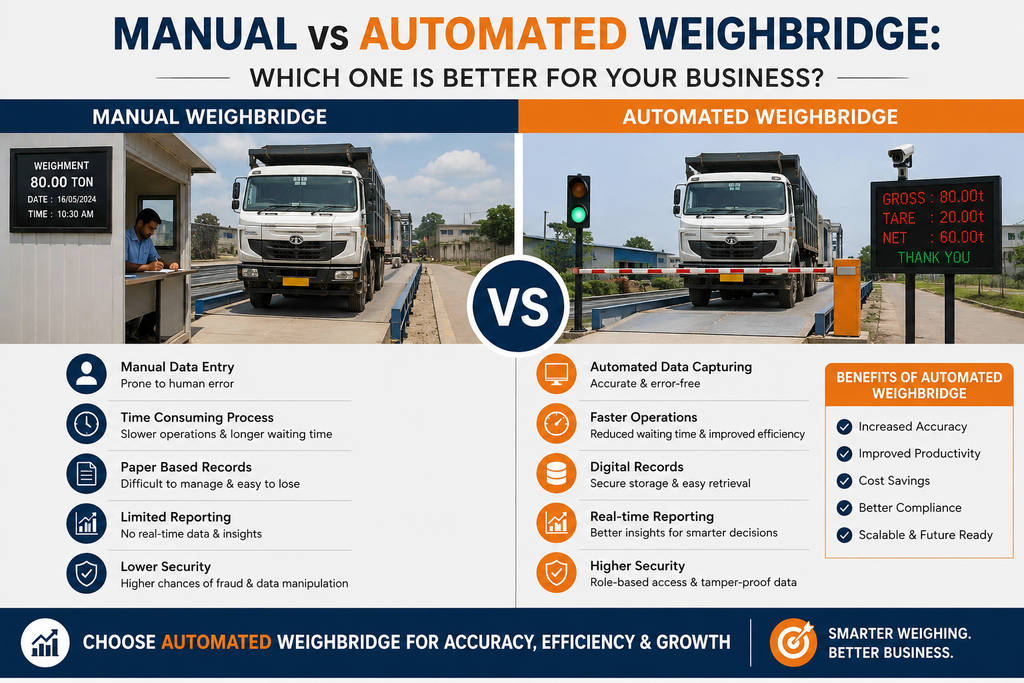
The biggest difference between the two systems is the level of human involvement. A manual weighbridge depends heavily on operators, while an Automated Weighbridge uses technology to manage many parts of the process.
| Feature | Manual Weighbridge | Automated Weighbridge |
|---|---|---|
| Vehicle Identification | Manual | RFID/ANPR/automated |
| Data Entry | Mostly manual | Automatic |
| Weight Recording | Operator-dependent | Digitally captured |
| Vehicle Movement | Manually controlled | Automated barriers/signals |
| Paperwork | High | Reduced |
| Human Error | Higher possibility | Lower |
| Security | Limited | Multiple automated checks |
| Reporting | Manual or semi-digital | Automated |
| ERP Integration | Limited/Manual | Possible through integration |
| Monitoring | Operator-based | Centralized/digital |
| Scalability | Limited | High |
| 24/7 Operation | Requires staffing | Can support unmanned operation |
| Fraud Control | More difficult | Stronger control mechanisms |
This comparison does not mean every manual weighbridge is inefficient or every automated system is perfect. The right solution depends on how the business operates and how much automation is required.
1. Accuracy and Reduction of Human Errors
Accuracy is one of the most important factors when choosing a weighing solution. In a manual setup, the operator may need to enter vehicle numbers, material details, customer information, and other transaction data. A typing mistake, incorrect vehicle number, wrong material selection, or incorrect transaction entry can create discrepancies between physical movement and digital records. When these errors happen repeatedly, they can affect inventory, billing, dispatch, and reconciliation.
An Automated Weighbridge directly connects the weighing process with software. Weight information can be captured automatically, while vehicle identification and other transaction information can be linked with the weighing record.
Benefits include:
- Reduced manual data-entry errors
- Consistent transaction recording
- Better traceability
- Faster reconciliation
- Improved inventory records
- More reliable weighing documentation
For businesses handling large quantities of material every day, even small improvements in data accuracy can have a significant operational impact.
2. Faster Vehicle Processing
Vehicle waiting time is another major concern for factories, mines, warehouses, logistics yards, and large industrial facilities. In a manual system, the driver may need to wait while the operator checks documents, enters data, records weight, prints the ticket, and completes the transaction. During busy periods, these small delays can create long queues.
With weighbridge automation, several activities can happen automatically. RFID can identify registered vehicles, sensors can assist with positioning, cameras can capture vehicle information, and barriers can control movement. This creates a more streamlined process.
Faster processing can help businesses:
- Reduce truck queues
- Improve gate efficiency
- Reduce vehicle idle time
- Increase daily vehicle handling capacity
- Improve driver experience
- Support smoother dispatch operations
For a plant processing hundreds of vehicles per day, improving the weighing process can make a noticeable difference to overall logistics efficiency.
3. Better Security and Fraud Prevention
Security is one of the strongest reasons businesses consider an automated weighbridge system. Manual processes may provide opportunities for incorrect data entry, unauthorized transactions, duplicate weighing, vehicle substitution, or other forms of manipulation. While proper supervision can reduce these risks, monitoring every transaction manually can be difficult in high-volume environments.
An automated system can combine multiple security technologies. RFID can identify authorized vehicles, ANPR can verify the vehicle registration number, CCTV can capture images, and sensors can confirm vehicle positioning. These technologies create multiple checkpoints during the weighing process.
Automated security features can include:
- RFID-based vehicle identification
- ANPR camera verification
- CCTV monitoring
- Automatic barriers
- Vehicle positioning sensors
- Transaction validation
- Digital audit trails
- User access control
- Automated exception detection
The result is greater visibility into who entered the facility, which vehicle was weighed, what weight was recorded, and when the transaction occurred.
4. Reduced Dependence on Paperwork
Paper-based processes can become difficult to manage when transaction volumes increase. Operators may have to maintain registers, print slips, store documents, and later enter information into spreadsheets or business software.
An Automated Weighbridge can digitize much of this information. Weighment data can be stored electronically, searched when required, and used for reporting.
Digital records can help with:
- Faster data retrieval
- Easier transaction tracking
- Reduced paperwork
- Better record keeping
- Easier reconciliation
- Improved audit preparation
This is particularly useful for companies operating multiple weighbridges or multiple plants where management needs access to centralized information.
5. Real-Time Reporting and Monitoring
One limitation of traditional manual operations is that management may not have immediate visibility into weighbridge activities. An automated system can provide digital reports and dashboards depending on the software configuration. Managers can monitor vehicle transactions, weights, material movement, pending transactions, and other operational information.
Reports may include:
- Daily weighment report
- Vehicle-wise report
- Material-wise report
- Customer-wise report
- Supplier-wise report
- Gross and tare weight report
- Dispatch report
- Receiving report
- Transaction history
- Exception or rejected transaction report
Real-time data can help management identify operational bottlenecks and make faster decisions.
6. ERP Integration
Modern businesses rarely operate their weighbridge as a completely separate system. Weighment information may need to connect with ERP, inventory, procurement, billing, dispatch, or fleet management software.
This is where ERP weighbridge integration and weighing data integration become valuable. An automated solution can be configured to exchange relevant information between the weighbridge software and business applications. For example, a dispatch order can be verified before weighing, and the final weight can be transferred to the appropriate business system.
ERP integration can support:
- Purchase management
- Sales and dispatch
- Inventory management
- Billing
- Material reconciliation
- Customer records
- Supplier records
- Fleet management
- Production-related material tracking
Before selecting a system, businesses should confirm whether the solution can integrate with their existing ERP and whether the required APIs or integration methods are supported.
7. Labour and Operational Efficiency
A manual weighbridge requires dedicated personnel to manage daily weighing activities. Depending on operating hours, traffic volume, and the number of weighbridges, businesses may need multiple shifts.
Automation can reduce repetitive manual tasks and allow employees to focus on activities that require human decision-making and supervision. This does not necessarily mean that every automated weighbridge should operate without employees. Many businesses prefer a semi-automated model where staff remain available for exceptions, security, maintenance, and operational support.
Automation can help reduce:
- Repetitive data entry
- Manual documentation
- Routine verification
- Ticket preparation
- Manual gate control
- Administrative workload
The actual labor savings will depend on the existing workflow and the level of automation implemented.
8. 24/7 Operational Capability
Many industrial facilities operate around the clock. A manual weighbridge requires operators to be available during every operating shift. An automated or unmanned weighing setup can support continuous operations by allowing vehicles to complete defined weighing steps without requiring an operator to remain physically present at the weighbridge.
This can be particularly useful for:
- Mining operations
- Steel plants
- Cement factories
- Power plants
- Logistics facilities
- Warehouses
- Bulk material handling facilities
Automated systems are designed to support extended operating hours while reducing dependence on continuous operator presence.
Is a Manual Weighbridge Still a Good Choice?
Yes. Automation is not automatically the best choice for every business. If your facility handles a small number of vehicles every day, has a simple weighing process, and does not require advanced integration or security features, a manual weighbridge may still be practical.
A manual system may be suitable when:
- Daily vehicle traffic is low
- Operations are relatively simple
- Budget is limited
- Manual records are acceptable
- There is no requirement for ERP integration
- Security requirements are basic
- An operator is already available
- Weighbridge transactions are easy to supervise
The key is to choose a system based on actual operational requirements rather than automation simply because it is a newer technology.
When Should You Choose an Automated Weighbridge?
An Automated Weighbridge becomes more attractive when the business handles high vehicle volumes, expensive materials, multiple shifts, or complex logistics operations.
Consider automation if your business:
- Handles hundreds of trucks regularly
- Experiences long vehicle queues
- Has frequent data-entry errors
- Requires better transaction security
- Needs real-time reports
- Operates multiple shifts
- Wants to reduce paperwork
- Needs ERP integration
- Requires better vehicle tracking
- Wants centralized monitoring
- Handles high-value materials
- Plans to expand operations
For large industrial facilities, the benefits of automation can extend beyond the weighbridge itself because faster and more reliable weighing can improve the overall movement of materials and vehicles.
What Should You Check Before Buying an Automated Weighbridge?
Choosing the right system is important because automation is not simply about installing software or adding an RFID reader. Before purchasing an automated weighbridge system, evaluate the complete solution, including hardware, software, integration, security, support, and scalability.
Important factors to consider:
1. Vehicle Identification:
Check whether the system supports RFID, ANPR, barcode, or other identification technologies required by your operation.
2. Integration Capability:
Confirm whether it can integrate with your ERP, inventory, billing, or fleet management software.
3. Security Features:
Look for CCTV, vehicle verification, barriers, sensors, user access control, and transaction audit trails.
4. Reporting:
Make sure the software provides the reports your management and accounts teams actually need.
5. Scalability:
The system should be capable of supporting additional weighbridges, vehicles, users, or locations as your business grows.
6. Local Support:
Technical support, maintenance, calibration coordination, spare parts availability, and service response are important for industrial weighing operations.
7. Ease of Use:
A technically advanced system is not useful if employees cannot operate or maintain it easily.
8. Data Security:
Ask how transaction data is stored, backed up, protected, and accessed by authorized users.
Manual vs Automated Weighbridge: Cost Comparison
Initial investment is one of the major differences between manual and automated systems. A manual weighbridge generally requires less investment in automation hardware and software. However, businesses should not compare only the initial purchase price.
The total cost of ownership can include labor, paperwork, errors, delays, maintenance, data management, security losses, and operational inefficiencies. An automated system usually requires a higher initial investment because it may include RFID, ANPR, cameras, barriers, sensors, software, networking, and integration. However, the long-term value can be higher when the system reduces repetitive work, improves throughput, strengthens security, and provides better data.
Businesses should compare:
- Initial investment
- Installation cost
- Software cost
- Maintenance cost
- Labour cost
- Downtime
- Transaction processing time
- Security risks
- Reporting requirements
- Integration requirements
- Expected business growth
A proper ROI analysis should consider both direct and indirect benefits instead of looking only at installation cost.
Manual vs Automated Weighbridge: Which One Is Better?
There is no universal answer for every business, but for high-volume industrial operations, an Automated Weighbridge generally provides more advantages than a traditional manual setup.
Manual weighing can remain suitable for smaller facilities where transaction volumes are low, and the process is easy to control. However, businesses experiencing increasing truck traffic, data errors, security concerns, paperwork, and operational delays should seriously consider weighbridge automation.
The biggest advantage of automation is not simply faster weighing. It is the ability to connect vehicle identification, weighing, security, documentation, reporting, and business systems into one controlled workflow.
Final Thoughts
The Manual vs Automated Weighbridge decision should be based on your business size, vehicle traffic, material value, security requirements, staffing model, and future growth plans. A manual system can provide a simple and economical solution for low-volume operations. But when a business processes a large number of vehicles every day, manual processes can become difficult to manage efficiently.
An Automated Weighbridge can help businesses improve weighing accuracy, reduce manual errors, speed up vehicle processing, strengthen security, reduce paperwork, provide better reporting, and connect weighbridge operations with ERP and other business systems. Modern automation solutions can also combine RFID, ANPR, sensors, barriers, cameras, and software to create a more controlled weighing environment.