

How Thermal Cameras Enhance Night-Time Anti Drone Tech Performance in India
India is witnessing a rapid rise in drone-based threats—illegal cross-border deliveries, espionage, drone-based smuggling, and even weaponised drones used by hostile groups. Many of these incidents happen during night-time, when visibility is low and conventional surveillance systems struggle to detect small aerial objects.
Indian defence agencies, police forces, and security teams at airports, refineries, power plants, and government buildings are now turning to Anti Drone Tech to counter these risks. But one key technology stands out in night operations:
Thermal Cameras.
Thermal imaging has become a critical component of modern Counter-Unmanned Aircraft Systems (CUAS) because it allows reliable detection, tracking, and identification of drones even in zero-light conditions.
This article explains how thermal cameras enhance night-time anti drone tech performance, their advantages, use cases in India, integration with radars and RF sensors, technical specifications, and future innovations.
The Growing Need for Night-Time Anti Drone Tech in India
India has unique risk zones where drones are commonly used during late evenings or nights:
1. Border areas like Punjab, Rajasthan, and Jammu
Smugglers and hostile groups use small quadcopters to drop arms, drugs, and explosives at night.
2. Airports and aviation zones
Night is a sensitive time for flight operations, and any drone near runway paths can cause shutdowns.
3. Chemical, oil & gas industries
Plants operate 24×7 and require constant aerial surveillance to prevent drone-based sabotage.
4. Defence bases & military installations
Night-time is an ideal cover for reconnaissance missions by hostile UAVs.
5. Government buildings
VIP zones and sensitive infrastructure often face night-time spying attempts.
In all these cases, thermal cameras provide a detection-layer that normal CCTV cameras cannot, making them essential in India’s anti-drone ecosystem.
Why Thermal Cameras Are Essential for Night-Time Drone Detection
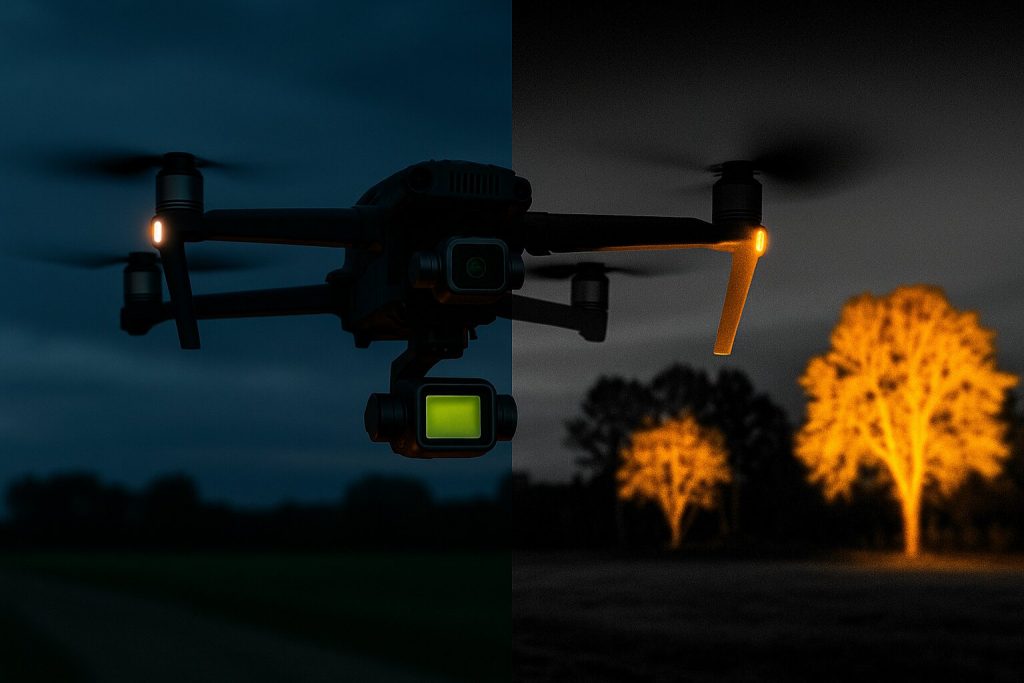
A thermal camera does not depend on visible light. Instead, it detects heat signatures, meaning it can capture UAVs based on their temperature difference from the surroundings.
This makes them highly effective for spotting:
- Small consumer drones
- Military-grade drones
- Fast-moving FPV drones
- Autonomous or pre-programmed drones
- Drones with minimal noise
India has large areas with zero street lighting, fog, dust, humidity, and heat, making traditional camera-based detection extremely difficult. Thermal imaging solves these environmental challenges.
How Thermal Cameras Work in Anti Drone Tech Systems
A thermal camera detects infrared radiation emitted by objects. Every object with a temperature above absolute zero emits IR heat waves. Drones, despite being small, generate noticeable heat signatures from:
- Motors
- Battery packs
- Electronic speed controllers (ESCs)
- Circuitry components
These components heat up when the drone is flying, making it visible to thermal sensors from long distances.
The Process:
- Thermal sensor captures heat signature
- AI/ML algorithm analyses the shape, movement, and heat patterns
- System differentiates drones from birds, aircraft, insects, and background noise
- System triggers alerts and tracks trajectory
- Anti drone jammers or countermeasures activate if required
Key Advantages of Thermal Cameras in Night-Time Anti Drone Tech
4.1 Works in Zero Light Conditions
Thermal cameras do not rely on sunlight or artificial lighting, enabling 24×7 detection.
4.2 Reliable in Indian climate conditions
They perform better than optical cameras in:
- Fog
- Light rain
- Dust
- Smoke
- Pollution
- High humidity
This makes them suitable for India’s diverse weather.
4.3 Harder to evade
Drones cannot hide their heat signatures—even if painted black or flying low. Smugglers cannot use camouflage to bypass detection.
4.4 Longer Detection Range
High-end Indian CUAS solutions with thermal cameras can detect drones up to 1–3 km depending on lens and sensor resolution.
4.5 Reduced false alarms
AI-powered thermal feeds eliminate bird movement, insect noise, or reflections, improving accuracy and confidence level.
4.6 Works with radar and RF sensors for multi-layer detection
Thermal imaging provides visual confirmation—essential for taking military or police action.
Integration of Thermal Cameras With CUAS Sensors
India’s Anti Drone Tech typically includes:
- 4D Imaging Radar
- RF Detector
- Thermal Camera
- Day Camera (EO)
- AI Video Analytics
- Jammers / RF Disruptors
How Thermal Cameras Complement Other Sensors
5.1 With Radar
Radar detects the drone first (big range).
Thermal camera confirms the target visually (medium range).
Both data sets fuse to improve tracking accuracy.
5.2 With RF Sensors
RF sensors detect drone communication signals.
Thermal camera verifies the presence of a drone even if RF is encrypted or suppressed.
5.3 With AI Video Algorithms
Thermal images feed AI to classify drones by:
- Motor heat pattern
- Rotor frequency behaviour
- Movement geometry
- Body shape thermal signature
This improves drone identification during hostile attacks.
Real-World Use Cases in India
6.1 Border Security Forces (BSF, ITBP)
India’s borders frequently face drone infiltration at night. Thermal imaging is now standard for:
- Detecting smuggling drones
- Tracking long-range UAVs from Pakistan
- Locating drone landing spots
- Supporting anti-smuggling operations
6.2 Indian Armed Forces
Army and Air Force use thermal cameras for:
- Surveillance in no-light zones
- Identifying hostile drones attempting reconnaissance
- Countering kamikaze or FPV drones
- Monitoring base perimeter security
6.3 Airports & Aviation Zones
Authorities use thermal imaging to:
- Detect drones near runways
- Track them during night landings
- Prevent flight disruptions
6.4 Oil, Gas & Refinery Zones
Thermal cameras help secure:
- Offshore/onshore refineries
- LNG terminals
- Petrochemical facilities
These are high-risk targets for drone sabotage.
6.5 Smart Cities & ITMS Integrations
Thermal cameras paired with AI improve:
- Government building security
- Event security
- Monitoring unauthorized drone flights over public areas
6.6 Police & Special Forces
Used in:
- VIP movement zones
- Stadiums and public events
- Riot control aerial monitoring
- Anti-smuggling & anti-terror operations
Technical Specifications That Matter for India
When choosing thermal cameras for CUAS, Indian agencies usually evaluate:
7.1 Sensor Type
- Uncooled VOx microbolometer (commonly used)
- Cooled IR sensors (high-end, long-range applications)
7.2 Resolution
- 320×256 (basic)
- 640×512 (standard CUAS)
- 1280×1024 (premium, long-range)
Higher resolution = better target clarity.
7.3 Lens Options
Longer focal lengths increase detection range:
- 19mm – short range
- 35mm – medium range
- 50mm–75mm – long range
- 100mm+ – ultra long range
7.4 Frame Rate
Higher frame rates allow better tracking of fast FPV drones.
7.5 Image Processing Features
- Auto gain control
- Noise reduction
- Dynamic scene enhancement
- AI-based signature extraction
7.6 Temperature Range
India requires cameras that perform in:
- Summer heat up to 50°C
- Winter low temperatures in northern regions
How Thermal Imaging Improves Drone Neutralization Accuracy
Anti Drone Tech involves both detection and neutralization.
Thermal imaging enhances neutralization by:
8.1 Confirming the drone before jamming
Avoids unnecessary jamming of non-threat objects.
8.2 Tracking true drone direction
Ensures jammers focus directional RF beams correctly.
8.3 Identifying drone type
- Consumer drones
- FPV drones
- Hexacopters
- Long-range military drones
8.4 Supporting automated response systems
Future CUAS will use thermal imaging to trigger:
- Autonomous jammers
- Laser neutralizers
- Automated tracking turrets
Future Trends: Thermal Imaging in India’s Anti Drone Tech Industry
The next wave of Indian CUAS innovation includes:
9.1 AI-enhanced thermal analytics
Better identification using heat signatures.
9.2 4D radar + thermal fusion engines
More accurate detection at long distances.
9.3 Integrated smart towers
Thermal cameras built into:
- Border towers
- Airport towers
- Defence smart posts
9.4 Drone-mounted thermal CUAS
Anti-drone drones with thermal payloads.
9.5 Low-cost thermal modules for mass deployment
India will shift toward scalable, indigenous CUAS solutions.
Why Thermal Cameras Are Critical for India’s National Security
India faces a unique combination of:
- Long international borders
- High-density cities
- Large defence infrastructure
- Rapid drone adoption
- Increasing rogue drone incidents
Thermal imaging provides the most reliable night-time detection layer, supporting:
- Drone tracking
- Anti-terror operations
- Critical infrastructure protection
- Border management
- Airspace monitoring
It also aligns with India’s Make in India and Atmanirbhar Bharat strategies by enabling indigenous CUAS innovation.
Conclusion
Thermal cameras are no longer optional—they are essential components of modern night-time Anti Drone Tech in India. Their ability to detect and track drones in complete darkness, extreme weather, and complex environments makes them indispensable for defence forces, police agencies, airports, industries, and smart cities.
As drones become more advanced, stealthier, and widely used by malicious groups, India’s CUAS ecosystem must continue integrating powerful thermal imaging systems to ensure safe, secure, and protected airspace.